Our history
Neighbours helping neighbours since 1557
The two charities share one long Stoke Poges tradition: the parish looking after its own.
The Hastings line
From Tudor almshouse to community fund
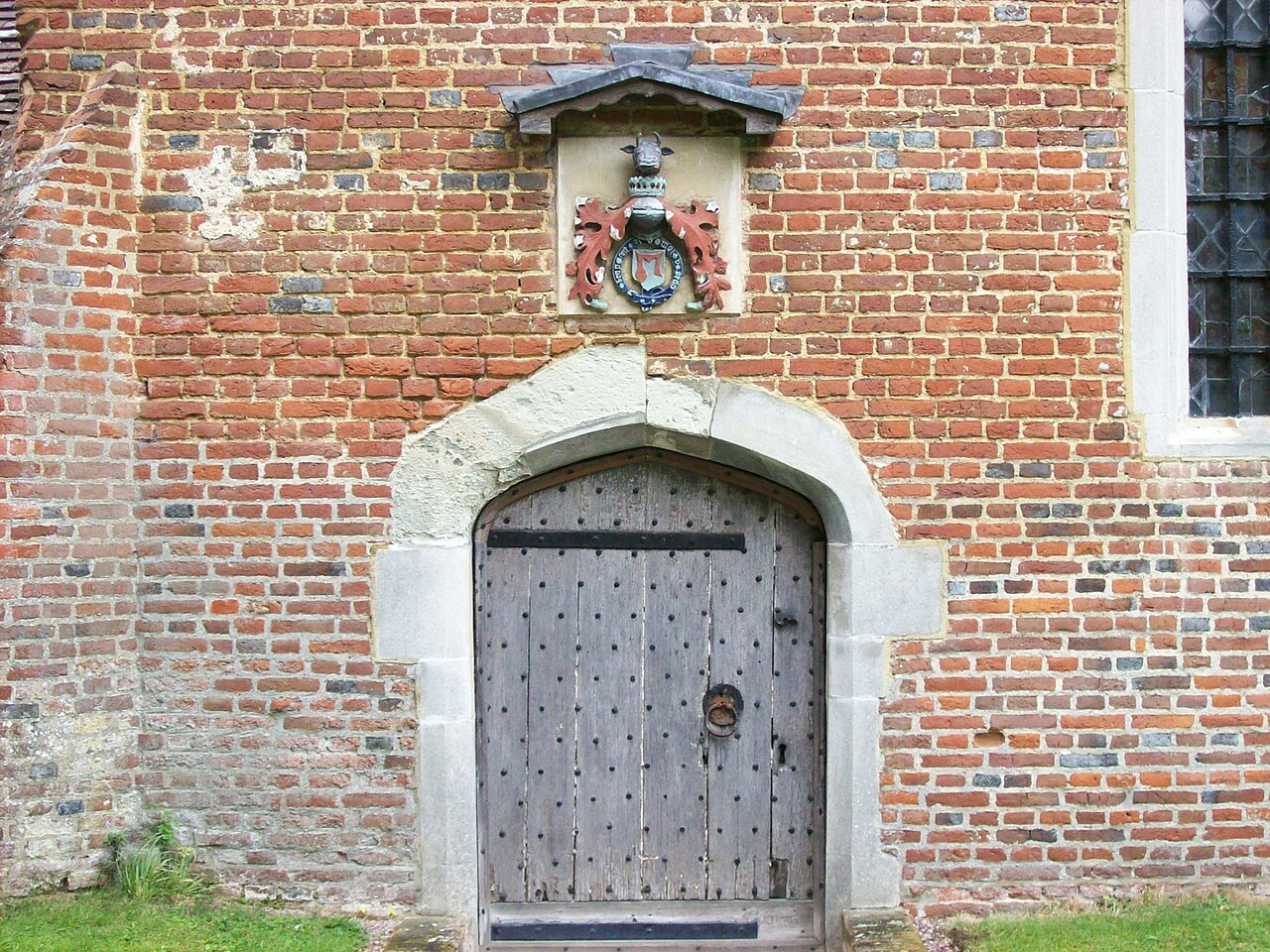
In 1557 Sir Edward Hastings — created Lord Hastings of Loughborough, son of the first Earl of Huntingdon — founded a hospital at Stoke Poges to support a master, four poor men and two poor women. The brick chapel he built for its inmates in 1558 still stands at St Giles' Church, bearing the Hastings coat of arms above its door.
The Lord Hastings Hospital Trust carried that foundation into the modern era. Reorganised by an Act of Parliament in 1856 and governed from 1980 by a statutory scheme, it retained the power to run almshouses — but its main work became grants for the relief of need. Its assets included Hastings Meadow, a 19-acre field let for horse grazing.
In January 2011 the Trust merged with the Stoke Poges Relief in Need charity to form today's Stoke Poges Hastings Community Fund.
The Common line
Fuel for the poor, funds for the village

Under the Stoke Poges and Wexham Enclosure Act of 1810, common land was set aside to provide fuel for the poor of the parish, and the Stoke Common Poor's Fuel Allotment Charity grew out of it in 1822.
By the late twentieth century the Common had become a liability for the trustees. In 1991 it was sold to South Bucks District Council — which could properly conserve its rare lowland heath, a Site of Special Scientific Interest now cared for by the City of London — and the invested proceeds, together with a bequest from the late Frank Solari, endowed the new Stoke Poges Relief in Need charity.
That charity is the other parent of the Hastings Community Fund — so every grant the Fund makes today traces back, in part, to the heathland of Stoke Common.
The United line
Small bequests, united for the parish
Over the centuries, Stoke Poges people left money to look after their poorer neighbours. In 1906 the Charity Commissioners brought four of these parish charities together under a single scheme as the "United Charities" — the ancestor of today's Stoke Poges United Charity.
- Lady Elizabeth Hatton (1647) — land at Wexham, for sickly, aged and impotent poor;
- Ann Church (1709) — to apprentice a poor boy of the parish;
- Mary Gardner (1805) — bread for the poor on the Sunday before Christmas;
- Mrs Parker Sedding (1812) — bread and linen for poor widows.
A further bequest from Mary Wiseman (1758) was distributed by the vicar and churchwardens among poor widows of the parish.
-
1557
Lord Hastings of Loughborough founds his hospital and almshouse at Stoke Poges; the Hastings Chapel follows in 1558.
-
1647–1812
Bequests by Lady Elizabeth Hatton, Ann Church, Mary Gardner and Mrs Parker Sedding create small charities for the poor of the parish.
-
1810 / 1822
The Enclosure Act sets aside common land to provide fuel for the poor; the Stoke Common Poor's Fuel Allotment Charity follows.
-
1856
An Act of Parliament confirms a new scheme for the Lord Hastings Hospital Trust.
-
1906
The Charity Commissioners unite the parish's small charities into a single "United Charities" scheme.
-
1991
Stoke Common is sold; the proceeds endow the Stoke Poges Relief in Need charity.
-
2011
The Lord Hastings Hospital Trust and the Relief in Need charity merge to form the Stoke Poges Hastings Community Fund.
-
Today
Two independent charities — the Hastings Community Fund and the United Charity — continue the tradition, giving grants to neighbours in need.